
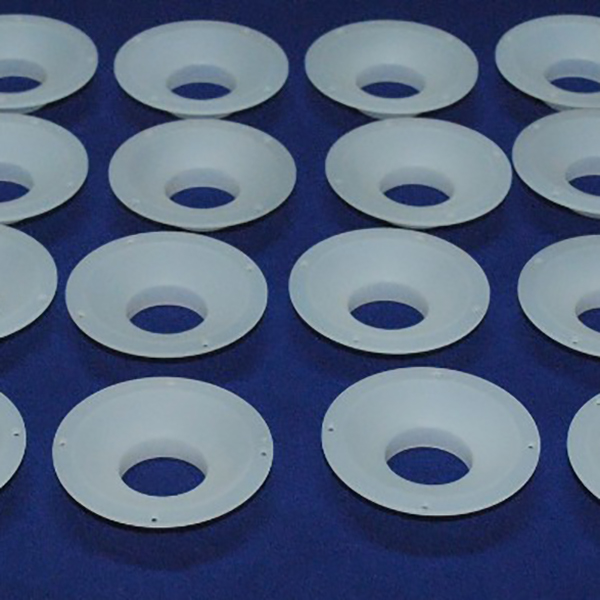
Redistribute illumination before it reaches the inspection field
This optical diffuser accessory is used when the lighting system needs a broader or smoother illuminated field. Its suitability depends on the light source, wavelength, beam geometry and required image contrast.
- Component
- Optical diffuser
- Lighting accessory
- Primary role
- Light redistribution
- System-dependent
- Selection basis
- Optical stack
- Light, diffuser, lens and target
- Validation
- Image comparison
- With and without diffuser
Uneven illumination
Evaluate a diffuser when local brightness variation is reducing useful contrast across the field.
Specular response
Test whether redistributing the incident light reduces distracting hotspots on reflective targets.
Broad-area lighting
Check whether the illuminated footprint becomes sufficiently uniform at the intended working distance.
Contrast trade-off
Confirm that smoothing the light does not remove the directional contrast needed to reveal the defect.
Judge the diffuser by measured field uniformity and defect contrast
The accessory record does not specify transmission, diffusion angle, wavelength band, thread or diameter. Those values must be confirmed for the selected part before release.
Flat-field image
Record brightness across the camera field with fixed exposure and lens settings.
Target comparison
Capture the same representative defect with and without the diffuser.
Exposure margin
Measure any additional exposure or light-output requirement introduced by the diffuser.
Spectral check
Verify the response using the actual light wavelength and camera sensitivity.
Release only after the image result improves
Approve the diffuser only when the final image shows the required uniformity or hotspot control while preserving the defect contrast and production exposure margin.
Specify the missing optical and mechanical attributes before ordering
No independent model matrix is available. Selection therefore requires the exact diameter, mounting interface and optical behavior to be confirmed for the intended lighting assembly.
- 1
Define the light source
Record type, emitting size, wavelength, working distance and available output margin.
- 2
Define the optical target
State the required diffusion angle, field uniformity and acceptable transmission loss.
- 3
Confirm physical fit
Obtain exact clear aperture, outer diameter, thickness and mounting interface.
- 4
Test the complete stack
Validate the light, diffuser, camera, lens and target under production exposure conditions.
Protect the clear aperture and keep the diffuser square to the light path
Exact dimensions are configuration-dependent and are not listed in the available accessory record. Confirm the selected part drawing before designing a holder.
Clear aperture
Avoid clipping the useful beam or placing retaining features inside the camera field.
Orientation
Mount the diffuser consistently and confirm any surface-direction requirement.
Protection
Keep optical surfaces clean and avoid stress, scratches and edge damage.
Service access
Allow removal and cleaning without changing the verified light and camera geometry.

