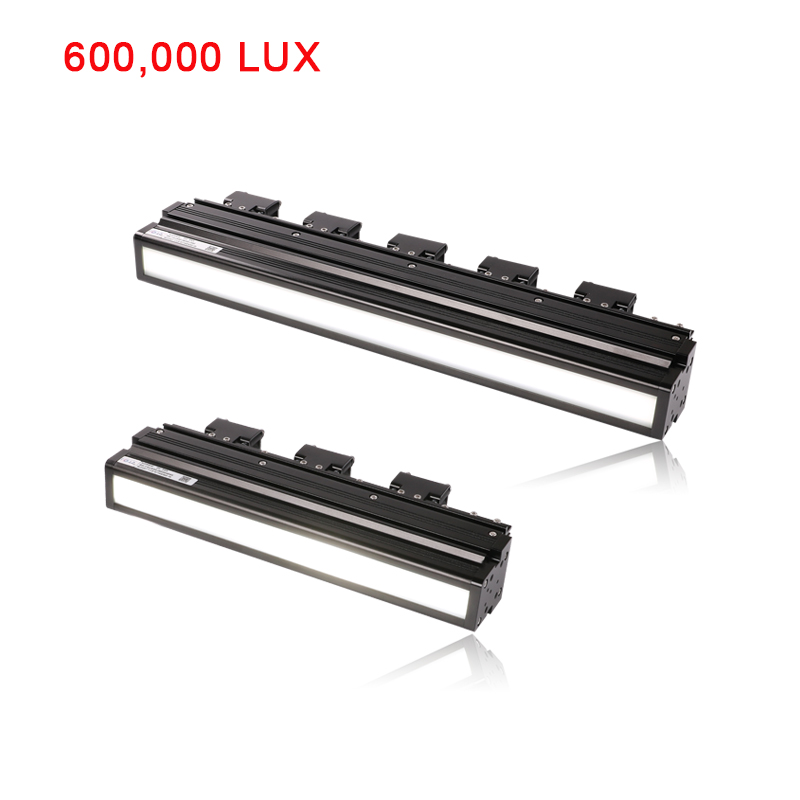
Two-sided oblique illumination for directional scratch inspection
LXV-2LIND is a fan-cooled double-angle oblique line light. Its special optical structure emits from both sides, helping line-scan systems reveal scratch defects that follow the direction of motion.
- Illumination geometry
- Double-angle oblique
- Sequential and left-right emission
- Listed illuminance
- 600,000 lx
- Both standard models
- Standard lengths
- 220 / 300 mm
- 204 / 284 mm emitting surface
- Cooling
- Fan cooling
- Keep airflow unobstructed
- Supply
- 24 V
- 90 W or 126 W by model
Transparent plastic surfaces
Use opposed oblique illumination to reveal directional surface marks on transparent plastic.
PET film scratches
The optical configuration is intended to increase the visibility of scratches along the moving direction.
Metal foil embossing
Use the two-sided oblique geometry where relief or directional marks need stronger contrast.
Glass screens
Inspect scratches or dirty areas while controlling reflections from the glossy surface.
Match the illuminated direction to the defect direction
The comparison highlights vertical scratches under the double-angle light. Confirm the final contrast with the real workpiece, camera position, working distance and line direction.
How working distance and two-sided light paths affect contrast
Review the output curve, light-path geometry, effective area and imaging examples as one continuous engineering reference before selecting a model.
Illuminance falls as working distance increases
The curve shown is for LXV-2LIND300-W. Use it as a setup reference, then measure the actual result after the target, angle and exposure have been fixed.


The double-angle rays arrive from sequential and left-right directions
The comparison multi-angle line-scan arrangement has only one direction. That difference is the optical basis for evaluating directional scratches.


One complete module: geometry, model limits and light distribution
A is the maximum effective emitting area. B is the effective working-distance range. The geometry, values and long-/short-side distribution images belong together and are therefore kept in one block.

| Model | A: max. effective area | B: working distance |
|---|---|---|
| LXV-2LIND220 | 204 mm | 345 mm |
| LXV-2LIND300 | 284 mm | 485 mm |
B is the effective working-distance range.


Vertical scratch contrast under the same camera
In the comparison, vertical scratch defects are highlighted under the double-angle oblique light when compared with a conventional line-scan light.


Black mobile-screen scratch inspection
Setup: black mobile screen, LXV-2LIND220-W. Oblique illumination makes the vertical scratch visible in the result image.
- Inspection content
- Black mobile-screen scratch
- Workpiece
- Black mobile screen
- Light model
- LXV-2LIND220-W
- Result
- Obvious scratch


Select housing length, colour and controller together
The two standard lengths share a 24 V supply and fan cooling, but power, weight and controller type differ.
- 1
Confirm the required emitting area
Use the 204 mm or 284 mm emitting-surface value and allow for alignment around the inspected width.
- 2
Choose colour for target contrast
Standard options are red, green, blue and white. UV and IR may be customized as required.
- 3
Match electrical load and controller
Use the exact model row: the 220 and 300 models specify different power and controller types.
- 4
Plan cooling and cabling
Reserve fan airflow, connector access and cable movement before releasing the mechanical design.
Read the configuration from the model code
LXV-2LIND##-R/G/B/W/IR/UV- LXV-
- Product prefix
- 2LIND
- Double-angle oblique light
- ##
- Contour length
- Colour code
- R, G, B, W; customizable IR or UV
Electrical, optical and mechanical values
Values remain tied to their model row to prevent cross-model mixing.
| Model | Voltage | Power | Peak illuminance | Weight | Controller | Drawing |
|---|---|---|---|---|---|---|
| LXV-2LIND220 | 24 V | 90 W | 600,000 lx | 1387 g | High-power constant-voltage controller | 1 |
| LXV-2LIND300 | 24 V | 126 W | 600,000 lx | 1893 g | High-power constant-current controller | 2 |
Colour data: red 620–630 nm; green 525–530 nm; blue 465–470 nm; white 6600 K at room temperature.
Environment: 0–40°C; 20–85% humidity without condensation.
Rated life: 50,000 hours to 50% luminance at the factory-default condition.
Common signal: Y. Both standard models use fan cooling.
Source service note: one year of free technical support and sample free-rent service are listed for the series.
Confirm project-specific options before ordering
- Cooling method
- Length
- Colour and colour temperature
- Cable length
- Installation method
PVC extension cable: high flexibility, bending resistance and high-temperature resistance for use inside the device.
High-flexibility extension cable: harder and more abrasion-resistant than PVC for drag-chain production lines.
The source page also identifies customized colour, on-site technical support and sample free-rent service.

Use the drawing assigned to the selected model
Dimensions are in millimetres. Confirm the emitting surface, housing envelope, mounting holes, connector and cable bend space.
LXV-2LIND220
- Housing length
- 220 mm
- Emitting surface
- 204 × 24 mm
- Body width
- 53 mm
- Width centre reference
- 26.5 mm
- Vertical references
- 83 / 121.5 / 116.28 mm
- Face-hole callout
- 2×4-M5 depth 6
- Cable bend reference
- 500 mm
LXV-2LIND300
- Housing length
- 300 mm
- Emitting surface
- 284 × 24 mm
- Body width
- 53 mm
- Width centre reference
- 26.5 mm
- Vertical references
- 83 / 121.5 / 116.28 mm
- Face-hole callout
- 2×4-M5 depth 6
- Cable bend reference
- 500 mm
Release the setup only after these items agree
- Model length and effective emitting area
- 24 V supply, model-specific power and controller type
- Fan airflow and operating environment
- Connector access, cable type and bend clearance